From the storm that felled 14 million trees, an object was born that replants them
The story of VAIA: circular economy explained through a wooden cube
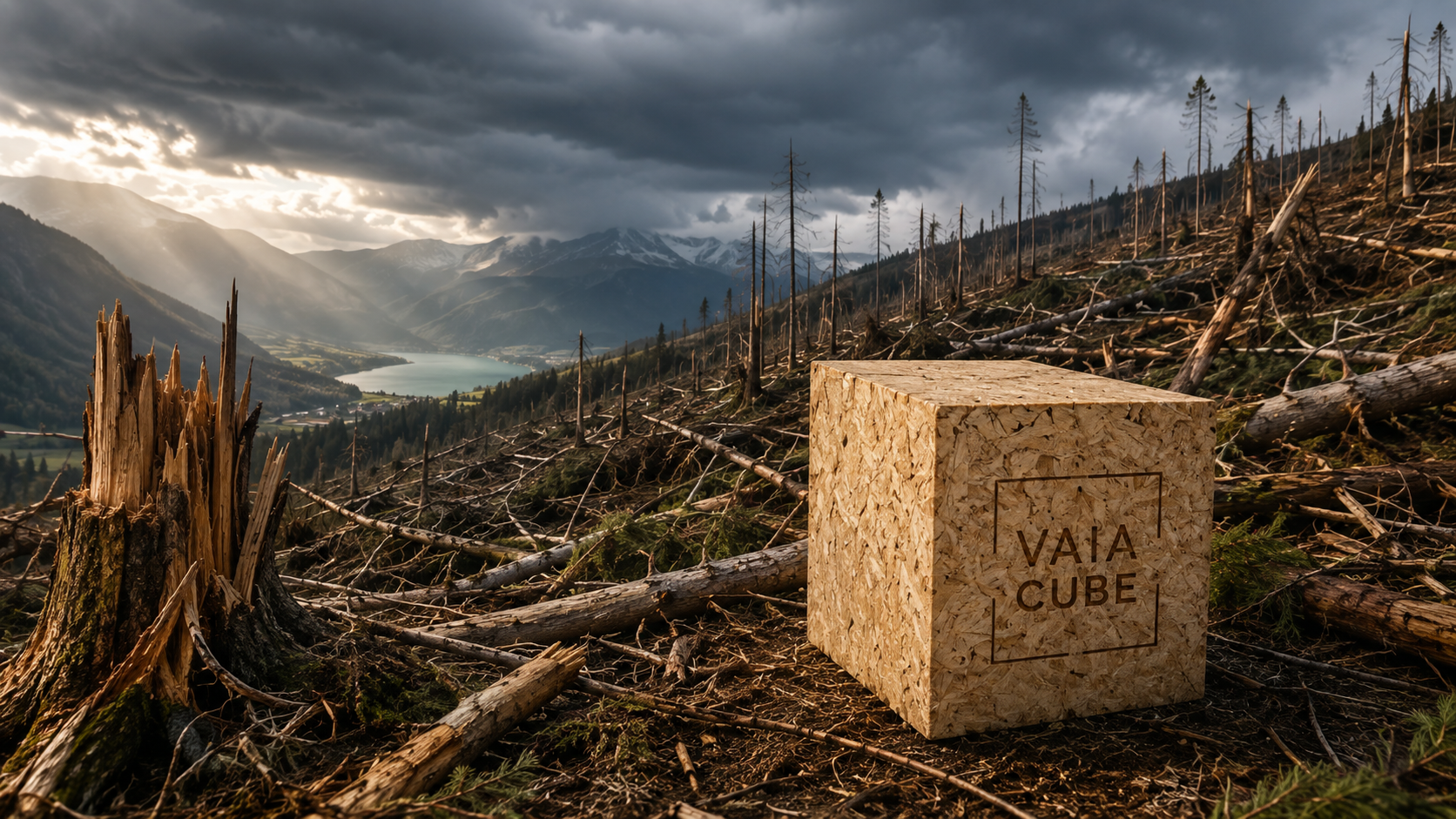
The idea: giving a voice to fallen trees
In 2018, the Vaia storm brought the Dolomites to their knees, felling 42 million trees in its wake. Three young men barely in their twenties chose to transform this environmental disaster into a resource. The question they started with was a practical one: what happens to all that wood? Left on the ground, it would have lost its value and attracted parasites, threatening even the trees that had survived. And so VAIA was born — the startup that turned the storm's fallen timber into a design object: the VAIA Cube, a passive amplifier for smartphones. No batteries, no electronics: it's the shape carved into the wood that amplifies the sound, just like the body of a guitar. You rest your phone in the slot, and the wood of the Dolomites does the rest.
The stroke of genius, however, isn't the object itself — it's the circle the object closes. The Cube is made from the wood of fallen trees, crafted by local artisans, and for every Cube sold, a new tree is planted in the very forests wounded by the storm. Buyers don't simply 'donate': they take part in a regeneration, and bring home a piece of a story. The wood tells the story of the wound; the planted tree tells the story of the future — and thousands of new trees have already taken the place of those that fell.
Why it works: circular economy you can touch
VAIA is a textbook case of circular economy — but without the textbook: no costly facilities, no proprietary technology, no million-dollar funding rounds to get started. All the ingredients were already there — a material considered 'waste', a local craft tradition in need of work, a powerful story — and the innovation lay in the way they were combined. It is upcycling in its purest form: not recycling downward, but transforming a by-product into something worth more than the original, by loading it with meaning.
There is also a communication lesson that applies to any business: VAIA has never had to explain its sustainability through certificates and slogans, because the product itself is the proof. Every Cube is traceable back to the storm that created it and to the tree it caused to be planted. When environmental impact is embedded in the product — visible, tangible, and worth telling — marketing stops being a cost: it becomes a consequence.
The lesson for companies and talents
VAIA's story speaks to anyone who thinks that making an impact requires extraordinary resources. To territories and businesses it says: look at your ”scraps” — materials, spaces, production traditions that seem out of the market — because that is where your most authentic product may be hiding. To young talents it says something even more direct: the founders had no twenty years of experience or capital — they had a problem right in front of their eyes, different and complementary skills, and the determination to start from a small object. A wooden cube, literally.
And it reminds everyone of the rule that sets apart sustainability projects that last from those that remain good intentions: start from a real wound, create genuine economic value, and make the impact measurable and visible — a tree planted is a number no one can dispute. The ecological transition is not made up of large infrastructures alone: it is also made — perhaps above all — of ideas like this one, small, intelligent and circular, like a cube that plays music.
Your territory also has wounds that can become projects. On Simbial, talents and companies transform them together into measurable impact.