The secret network beneath the forests
Mycorrhizae and the symbiosis between trees and fungi: the oldest technology on the planet — and the most modern
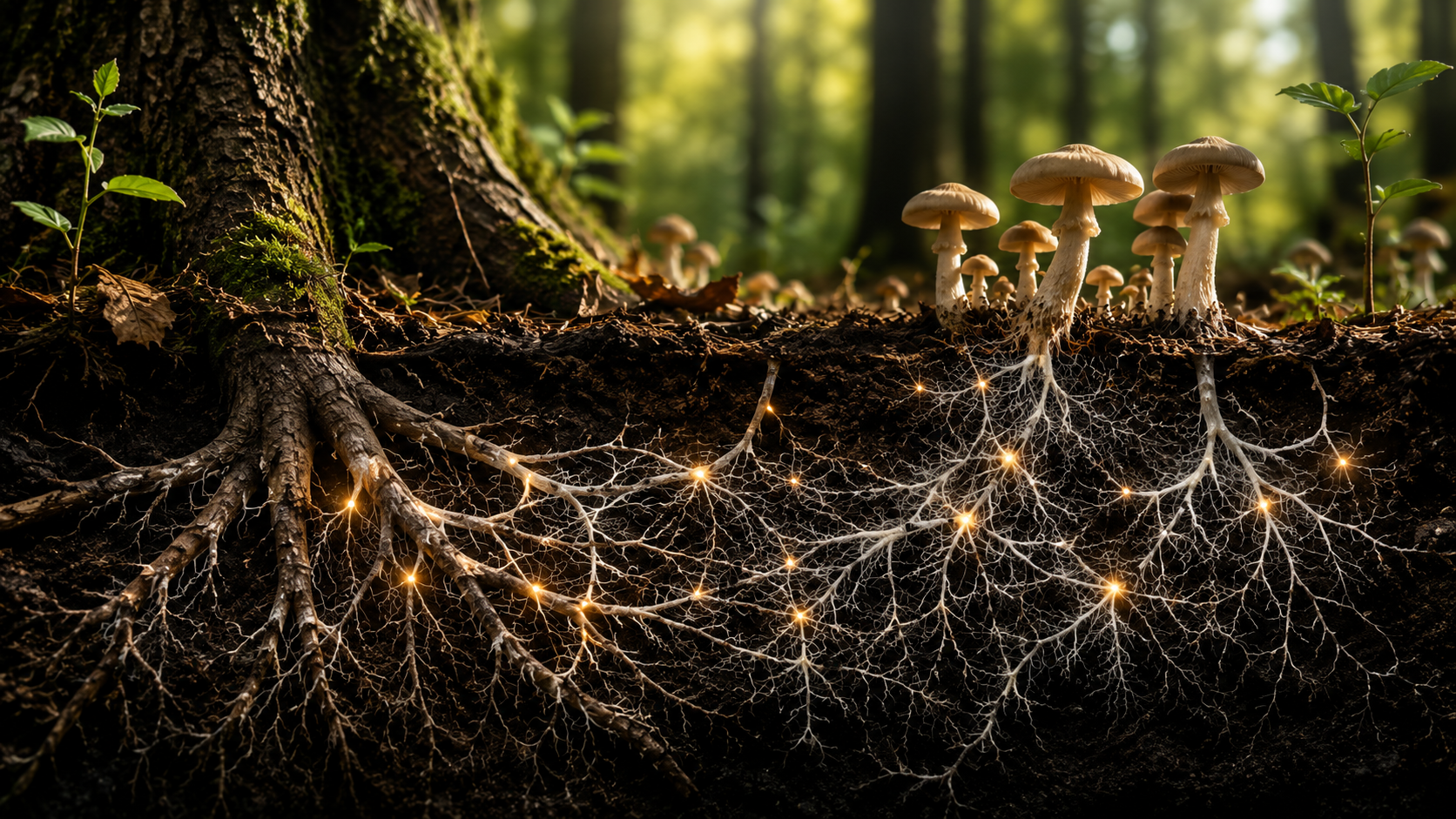
The pact between trees and fungi
The protagonists of this network are fungi — not the caps that sprout after rain, which are only the "fruit", but the mycelium: kilometres of extremely fine filaments that intertwine in the soil. When the filaments meet a root, they form an ancient pact with it that botanists call mycorrhiza, literally "fungus-root". The exchange is a textbook example of economics: the tree, which produces sugars through photosynthesis, gives a share of them to the fungus, which, unable to photosynthesise, needs them to survive; the fungus, in return, places its network of filaments at the tree's service — capable of exploring the soil with a capillarity no root could ever match — and delivers water, phosphorus, nitrogen and minerals that would otherwise be out of reach. Neither could thrive alone: together, they colonised dry land. This is no rare occurrence — it is the rule: the vast majority of land plants live in mycorrhizal symbiosis, and have done so for hundreds of millions of years. The forests we admire exist thanks to this invisible contract.
A network that redistributes
The most fascinating aspect is what the network makes possible between trees. Studies on forests — made famous by the work of Canadian ecologist Suzanne Simard — have shown that resources can travel between trees through shared fungi: carbon passing from one species to another with the seasons, water moving towards those under stress, seedlings growing in the shade receiving support from nearby mature specimens. How dense this "dialogue" truly is remains the subject of lively research — science is happy to debate its own metaphors, and that is its strength — but the observed principle remains remarkable: the system tends to redistribute resources where they are needed, and a connected woodland proves more resilient than a sum of isolated trees. This is confirmed, in negative terms, by the experience of forestry: sterilised soils and monocultures stripped of their fungal networks produce trees that are more fragile, more thirsty, more exposed.
There is also a detail that concerns the climate: mycorrhizal networks are an important pathway through which carbon captured by plants is transferred and stabilised in the soil — and the planet's soils hold more carbon than the atmosphere and forests combined. Every time a living soil is protected, that invisible bank keeps working.
The oldest technology on the planet
Why talk about fungi on a platform dedicated to innovation? Because mycorrhizal symbiosis is the greatest existing case study on how positive impact is generated, and its rules seem written for anyone building projects today. Specialisation creates value only when there is exchange: the tree knows how to do one thing, the fungus another, and wealth is born from trade between the two — as in every well-composed team, where diverse skills are worth more than their sum. Connections beat size: in the forest, it is not the largest tree that wins but the most connected system; in human organisations, those who collaborate across networks outperform those who accumulate alone. Resilience is a property of the network, not of individuals: when drought arrives, it is the forest that shares that survives.
Evolution, in short, is not made of competition alone: its most important leaps — from mycorrhizae to coral reefs, right through to the very cells we are made of, born from ancient fusions between organisms — are the children of collaboration between different beings. It is an idea that nature has been experimenting with successfully for half a billion years, and one that is more relevant than ever today for those designing the ecological transition: the greatest impact is never generated by a single actor alone, but by a well-built symbiosis.