The invisible forest of the Mediterranean
Posidonia: it captures carbon for millennia, protects beaches, produces oxygen. Italy's greatest green infrastructure was built by no one
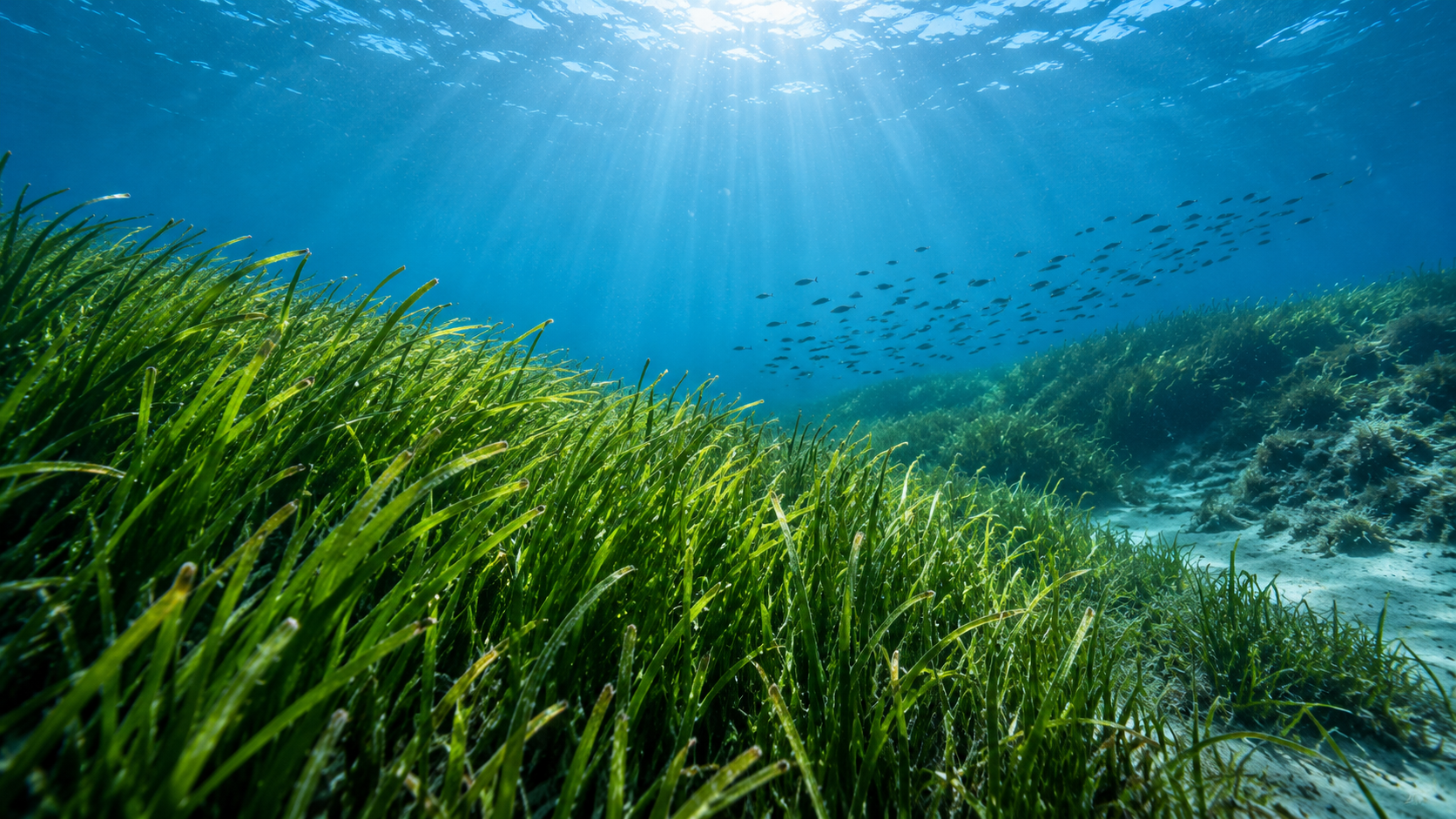
A forest no one planted
Underwater, posidonia forms meadows that stretch across thousands of hectares along the Italian, Spanish, and Greek coasts: true submerged forests, between 1 and 40 metres deep, where light can still reach. And like every forest, it works. Every day its leaves photosynthesise and release oxygen — healthy meadows produce it in enormous quantities, earning them the name "the lungs of the Mediterranean". Among its fronds, a disproportionate share of our sea's life reproduces and hides: hundreds of species of fish, molluscs and crustaceans use the meadows as nurseries, which means that a portion of Mediterranean fishing literally depends on this plant.
But posidonia's masterpiece is invisible and lies beneath the surface: over centuries, the plant accumulates dead leaves, roots and sediments into a compact structure called matte, which rises by a few millimetres each year and can reach several metres in thickness. Inside the matte, the carbon captured through photosynthesis remains trapped for centuries and millennia — a phenomenon scientists call blue carbon, the blue carbon of coastal ecosystems. For an equivalent surface area, seagrass meadows are among the most efficient and most stable carbon capture systems in existence — a natural reservoir that does not burn in wildfires and does not empty with a single cut, as can happen to a terrestrial forest. Some Mediterranean meadows have been growing in the same spot for thousands of years; in the Balearic Islands lives a posidonia clone considered one of the oldest living organisms on Earth.
The coastal engineer that never sends an invoice
There is also a service posidonia provides to the economy every single day, and which almost no one gives it credit for: it defends the coastline. The meadows dampen the force of waves before they reach the shore, and the banquettes of beached leaves protect the sand from winter erosion, returning it intact come summer. Where the meadows die — through anchoring, trawling, coastal construction or turbid waters — beaches begin to retreat, and municipalities find themselves paying millions for sand replenishment and artificial barriers to do, less effectively, the work the plant did for free. Economists call it natural capital: the value of the ecosystem services that nature provides without issuing an invoice — and which we only realise we have to pay for once it stops working.
What an impact lasting a millennium can teach us
Posidonia is a lesson in positive impact design, written long before the expression even existed. First: the greatest impact is often what goes unseen — the carbon in the matte, the dampened waves, the dissolved oxygen: none of these benefits are photogenic, yet all of them are measurable. Second: consistency beats power — a few millimetres per year, over a thousand years, builds more than any spectacular gesture; this is the logic behind every serious sustainability project. Third: protecting what already works is the highest-return project there is — replanting posidonia is possible but slow and costly, while keeping an anchor out of a meadow costs nothing; in the ecological transition, conservation is the investment with the best cost-to-environmental-impact ratio.
For a coastal business, a municipality, or a professional in tourism or fishing, the meadow just offshore is not scenery: it is infrastructure on which revenues, beaches, and climate all depend. The first step to protecting it is the same as with any impact: get to know it, and measure what it does for us.